
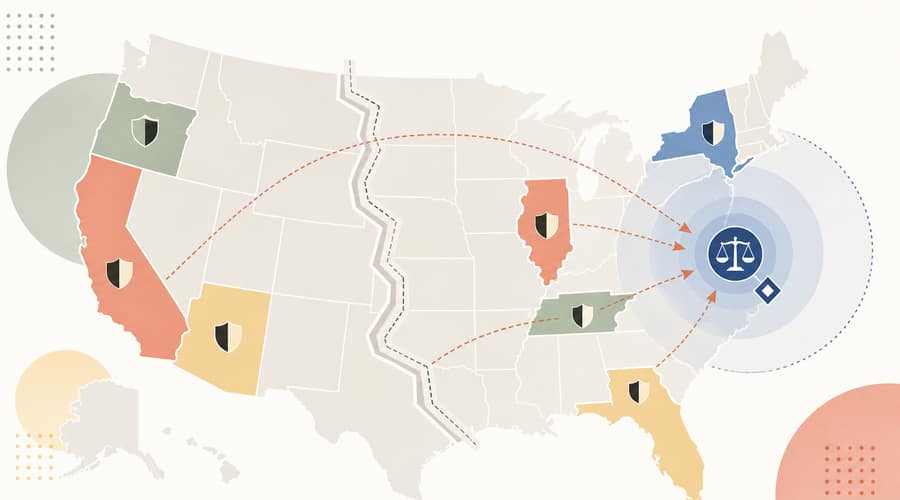
New York is seeking at least $36 billion from Kalshi in a July 31 lawsuit that accuses the prediction-market exchange of offering unlicensed gambling products to state residents. The case puts Attorney General Letitia James and Governor Kathy Hochul on the state-law side of a jurisdictional fight that the Commodity Futures Trading Commission is already litigating in federal court.
The state complaint asks a New York court to block Kalshi from offering the challenged event contracts in New York, order restitution, require disgorgement, and impose civil penalties. Kalshi’s central defense is that its contracts trade through KalshiEX LLC, a federally registered designated contract market supervised by the CFTC, rather than through a state-licensed sportsbook.
What did New York accuse Kalshi of doing?
New York’s attorney general accused Kalshi of offering sports, culture, and election event contracts to New York users without a license from the New York State Gaming Commission. The July 31 complaint says the products function as gambling under New York law because users stake money on uncertain outcomes outside their control.
The state’s temporary restraining order papers seek at least $36 billion in compensatory damages, subject to a full accounting. The requested relief also includes restitution to users, disgorgement of proceeds, treble penalties, and $100,000 for each allegedly unlawful offering.
The lawsuit also focuses on age restrictions. New York says Kalshi made event contracts available to users between 18 and 20, even though New York’s legal age for mobile sports betting is 21. The attorney general’s theory is that the platform exposed younger residents to the financial risks of gambling while operating outside the state’s licensing system.
Kalshi disputes that framing. The company has argued in related litigation that contracts listed on a CFTC-regulated exchange are derivatives subject to federal commodities law, not state gambling products that must be licensed market by market.
How did Kalshi’s federal New York case reach this point?
Kalshi had already sued New York gaming officials before James filed the July 31 state action. In KalshiEX LLC v. Williams, No. 1:25-cv-08846 in the Southern District of New York, Kalshi sought emergency relief against the New York State Gaming Commission after a 2025 cease-and-desist order.
U.S. District Judge Analisa Torres denied Kalshi’s request for a temporary restraining order and preliminary injunction on July 7. In a July 13 corrected order, the court said the CFTC holds authority under the Commodity Exchange Act to determine whether certain event contracts are contrary to the public interest, but rejected Kalshi’s request to stop New York from enforcing its gambling laws while the case continued.
The New York attorney general’s office characterized the ruling as a court victory in a July 8 statement issued with Hochul. The office said Kalshi had “lost its lawsuit against the New York Gaming Commission,” and James said New York would continue to hold gambling platforms accountable, including prediction markets.
The federal ruling did not end the dispute. It left Kalshi facing state enforcement while the broader question moves through multiple courts: whether federal registration as a designated contract market preempts state gambling, licensing, and consumer-protection laws when the listed contracts involve sports or other public events.
What role is the CFTC playing?
The CFTC is taking the opposite jurisdictional position from New York. In Release 9267-26, dated July 14, the agency said the Commodity Exchange Act requires a uniform national market in derivatives transactions and nondiscriminatory access to CFTC-regulated markets. The release also said the CFTC has filed lawsuits against Arizona, Connecticut, Illinois, Kentucky, Minnesota, New Mexico, New York, Rhode Island, and Wisconsin to protect the jurisdiction Congress gave the agency.
The clearest emergency action so far came in Michigan. In the same July 14 release, the CFTC said it stayed an emergency rule change proposed by KalshiEX after a Michigan state court order directed the company to cancel certain previously executed trades involving Michigan residents. The agency also ordered KalshiEX to fulfill open trades under its normal practices.
CFTC Chairman Michael S. Selig framed the Michigan action as a market-structure issue. He said a state cannot force a designated contract market to violate its federal obligations, and that cancelling executed trades could undermine contracting certainty across the marketplace.
That order did not decide the merits of every state gambling claim against sports event contracts. It did show that the CFTC is willing to intervene when a state order would require a registered exchange to unwind trades that have already been executed.
How many states are involved in the jurisdiction fight?
The CFTC’s July 14 release lists nine state lawsuits brought by the agency: Arizona, Connecticut, Illinois, Kentucky, Minnesota, New Mexico, New York, Rhode Island, and Wisconsin. It also says the Commission has filed amicus briefs in the U.S. Courts of Appeals for the Sixth and Ninth Circuits and in the Supreme Judicial Court of Massachusetts.
State attorneys general have organized on the other side. In an April 24 statement, the New York attorney general’s office said James joined 37 other attorneys general in an amicus brief supporting Massachusetts’ lawsuit against Kalshi. The coalition argued that Kalshi’s preemption theory threatens states’ authority to enforce gambling laws, set age limits, collect tax revenue, and protect consumers.
New York has also sued other prediction-market operators. On April 21, James sued Coinbase Financial Markets and Gemini Titan, alleging that their prediction-market products violated New York gambling laws. Those cases are separate from the Kalshi lawsuit, but they show that the state is treating prediction markets as a broader enforcement category, not as a one-company dispute.
Where do Polymarket, Coinbase, and Gemini fit?
New York City has opened a separate consumer-protection inquiry into Kalshi, Polymarket, Coinbase, and Gemini Titan. The Wall Street Journal reported that City Council Speaker Julie Menin sent letters on Aug. 11 asking the companies more than 60 questions about revenue tied to New York City, city user counts, marketing operations, and compliance with consumer-protection laws.
The council inquiry is not the same as James’s state-court lawsuit. It does not by itself impose criminal penalties or resolve whether event contracts are gambling under state law. It can, however, lead to subpoenas, hearings, and local legislation focused on advertising, public education, and consumer safeguards.
Polymarket’s position differs from Kalshi’s because the companies have different regulatory histories and product structures. Still, the questions now facing city and state officials overlap: how prediction markets market event contracts, what user groups they reach, whether minors are exposed to speculative products, and whether state gambling rules apply even when a platform presents itself as a financial market.
What is the legal question for Kalshi now?
The immediate question is whether New York courts will let state officials restrict Kalshi’s New York activity while federal preemption litigation continues. The broader question is whether a CFTC-regulated exchange can list sports-linked event contracts nationwide without obtaining state gambling licenses.
A ruling for New York would strengthen state leverage over sports event contracts and could push exchanges toward state-by-state geofencing, product restrictions, or licensing talks. A ruling for Kalshi or the CFTC would support the industry’s argument that federally regulated event-contract markets cannot be controlled through separate state gambling regimes.
The next dated milestone is Aug. 25, 2026, the response deadline implied by Menin’s Aug. 11 City Council letters giving Kalshi, Polymarket, Coinbase, and Gemini Titan 14 days to answer. In court, the higher-stakes event remains New York’s request for restrictions against Kalshi and the appeal path from Judge Torres’s July 7 ruling in KalshiEX LLC v. Williams.