
Meta description: Kalshi listed $2.24 million in UNC-TCU volume before kickoff, far above Polymarket’s $759, as sports contracts met legal pressure.
Tags: Kalshi, Polymarket, CFTC, North Carolina, TCU, College Football
Market platform: none-if-cross-platform
Category: Industry
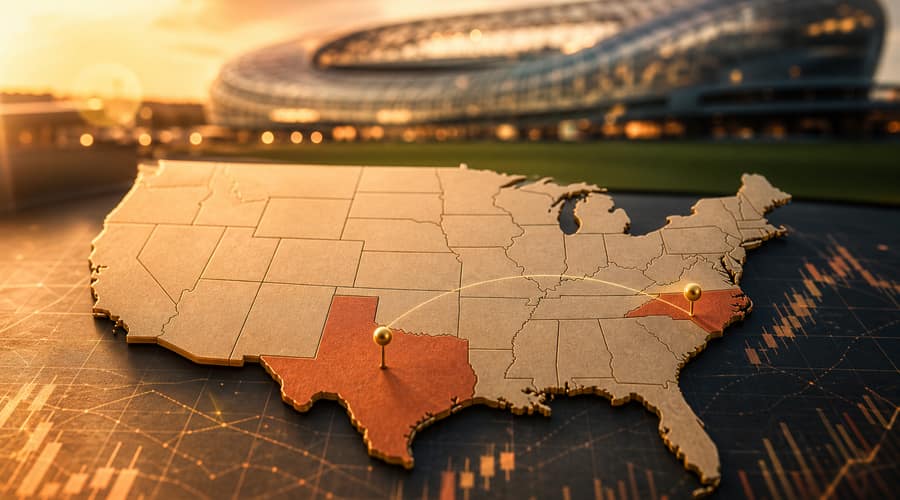
Kalshi entered the North Carolina-TCU opener with far more visible volume on that matchup than Polymarket. Kalshi’s public North Carolina vs. TCU market page listed TCU at 77%, North Carolina at 25% and $2,235,749 in volume before the Aug. 29 kickoff, while Polymarket’s page listed TCU at 76%, North Carolina at 25% and $759 in volume.
The game at Aviva Stadium in Dublin gave prediction-market operators an early college-football test with a clean comparison: similar headline probabilities, sharply different public volume. The matchup also arrived while Kalshi, a federally designated contract market, was fighting state gambling regulators over whether sports event contracts can be offered under the Commodity Exchange Act without state sportsbook licenses.
What did Kalshi and Polymarket prices say about UNC vs. TCU?
Both platforms priced TCU as a clear favorite. Kalshi’s public market page for North Carolina vs. TCU showed TCU at 77% and North Carolina at 25%, with $2.24 million in volume. Polymarket’s public market page for the same game showed TCU at 76% and North Carolina at 25%, with $759 in volume.
The similarity in price matters because it narrows the difference between the platforms to market structure, access and execution. A 76-cent or 77-cent contract implies that traders are paying roughly three quarters of a dollar for a contract that pays $1 if TCU wins. The displayed probability is only part of the trading experience; the rest depends on order-book depth, spread, fees, funding mechanics and whether a user can access the product in their jurisdiction.
Polymarket’s market page said the North Carolina vs. TCU market opened Aug. 24, 2026 at 6:00 p.m. ET, ended Aug. 29 and would resolve based on NCAA results. Kalshi’s page described the matchup as an NCAA Football market for Aug. 29 and cited ESPN for the game details, including the noon ET kickoff on ESPN and Disney+.
How large was Kalshi’s college-football futures market?
Kalshi’s larger college-football footprint was clearest in futures, not only in the Dublin opener. Kalshi’s public team-market pages identified the relevant season-long market as “College Football National Championship Winner” and showed more than $16.5 million in volume across 50 markets around Week 0.
That is the market name that matters for traders tracking season-long college-football liquidity. It is separate from other listed Kalshi markets, including “College Football Playoff Qualifiers,” “College Football National Championship Qualifiers” and conference championship winner markets. The national championship winner market is the cleaner benchmark for broad title-market activity because it aggregates interest across the leading teams rather than a single game.
For a trader, volume is not a branding point. It affects whether an order can be entered or exited without moving the price. Thin markets can still show intuitive probabilities, but they may be harder to trade at scale. Deeper markets can make event contracts look more like financial trading products, especially when prices are moving around kickoff, injuries, weather or line movement in adjacent sportsbook markets.
How did affiliate promotions fit into the Week 0 push?
Kalshi and Polymarket were marketed through sports-media affiliate pages as college football began, but those pages should be read as commercial acquisition channels rather than independent evidence of product strength. The more useful facts are the offer terms, the named outlet and the restrictions each page disclosed.
Covers promoted the Kalshi code COVERS35 in an Aug. 24 page, describing a “trade $25, get $35” new-user offer and noting that eligibility restrictions and Kalshi terms applied. Rocky Top Insider promoted the Kalshi code ROCKY in a July 26 page, describing a variable bonus credit ranging from $15 to $500 after $25 in trades within 30 days. Denver Stiffs promoted the Polymarket code STIFFS in an Aug. 21 page, describing a $20 sign-up bonus tied to a $10 trade and listing U.S. eligibility restrictions.
Those promotions show that prediction-market firms are being sold to sports audiences through some of the same affiliate-style pages that cover sportsbooks. They do not show, by themselves, that users will remain active after claiming a bonus. The harder question for exchanges is whether promotional traffic turns into repeat trading across weekly college-football slates, futures markets and in-game price movement.
What legal backdrop matters for Kalshi sports contracts?
Kalshi’s legal position starts with federal designation. The CFTC announced on Nov. 4, 2020, in Release No. 8302-20, that it issued an Order of Designation granting KalshiEX LLC status as a designated contract market under Section 5 of the Commodity Exchange Act and CFTC Regulation 38.3(a).
That federal status has not ended the state-law fight over sports contracts. In KalshiEX LLC v. Williams, No. 25-cv-08846, Judge Analisa Torres of the U.S. District Court for the Southern District of New York denied Kalshi’s motion for a preliminary injunction on July 7, 2026, according to the court’s Opinion and Order at ECF No. 106. The order held that Kalshi had not shown a sufficient likelihood that New York gambling laws were preempted as applied to Kalshi’s sports-event contracts.
The next month, the U.S. Court of Appeals for the Ninth Circuit issued another important ruling in KalshiEX LLC v. Assad, No. 25-7516. In its Aug. 28, 2026 opinion, the panel affirmed in part an order dissolving a preliminary injunction in Kalshi’s Nevada case and said Kalshi had not shown a likelihood that the Commodity Exchange Act preempts state gaming regulations as applied to its sports event contracts. The opinion also remanded part of the case involving election contracts.
Those rulings make jurisdiction more than a fine-print issue. Availability, onboarding, affiliate marketing and the practical ability to trade sports contracts can vary depending on state enforcement positions and court orders. For users comparing Kalshi and Polymarket, the relevant questions are concrete: what entity operates the market, where the user is located, how the market resolves, how funds move and what rules apply if a dispute arises.
Why does liquidity matter more than the bonus?
Referral campaigns can bring users to a market, but liquidity determines what happens after they arrive. In a binary sports contract, buying TCU at 77 cents means paying 77 cents for a contract that pays $1 if TCU wins and $0 if it loses. A trader still has to account for fees, opportunity cost and the spread between bids and offers.
College football is a useful stress test because the sport produces a recurring schedule with many simultaneous games, active fan bases and frequent information shocks. A single showcase game in Dublin can concentrate attention. A full Saturday requires platforms to support depth across multiple contracts at once, including moneyline-style markets, totals, spreads and season-long futures.
The UNC-TCU comparison showed a clear split before kickoff: similar probabilities on the two public market pages, but a much larger listed volume figure on Kalshi for that game. Kalshi’s national championship winner market added another sign of season-long activity, with more than $16.5 million in listed volume around Week 0.
What is the next measurable milestone?
The immediate milestone is market resolution after the North Carolina-TCU final score on Aug. 29, 2026. Polymarket’s rules named NCAA.com as the resolution source for its market, and Kalshi’s event page tied the contract to the same scheduled matchup. That final result will settle the opener; the larger test comes from whether trading depth holds across the rest of the Aug. 29 college-football schedule and into Week 1.
For Kalshi, the number to watch is whether the $2.24 million UNC-TCU market and the larger College Football National Championship Winner market translate into repeated single-game liquidity. For Polymarket, the question is whether sports affiliate campaigns can build order-book activity beyond low-volume listings. The next data point is not another promo code. It is the volume visible across the next college-football markets after the Dublin opener resolves.